

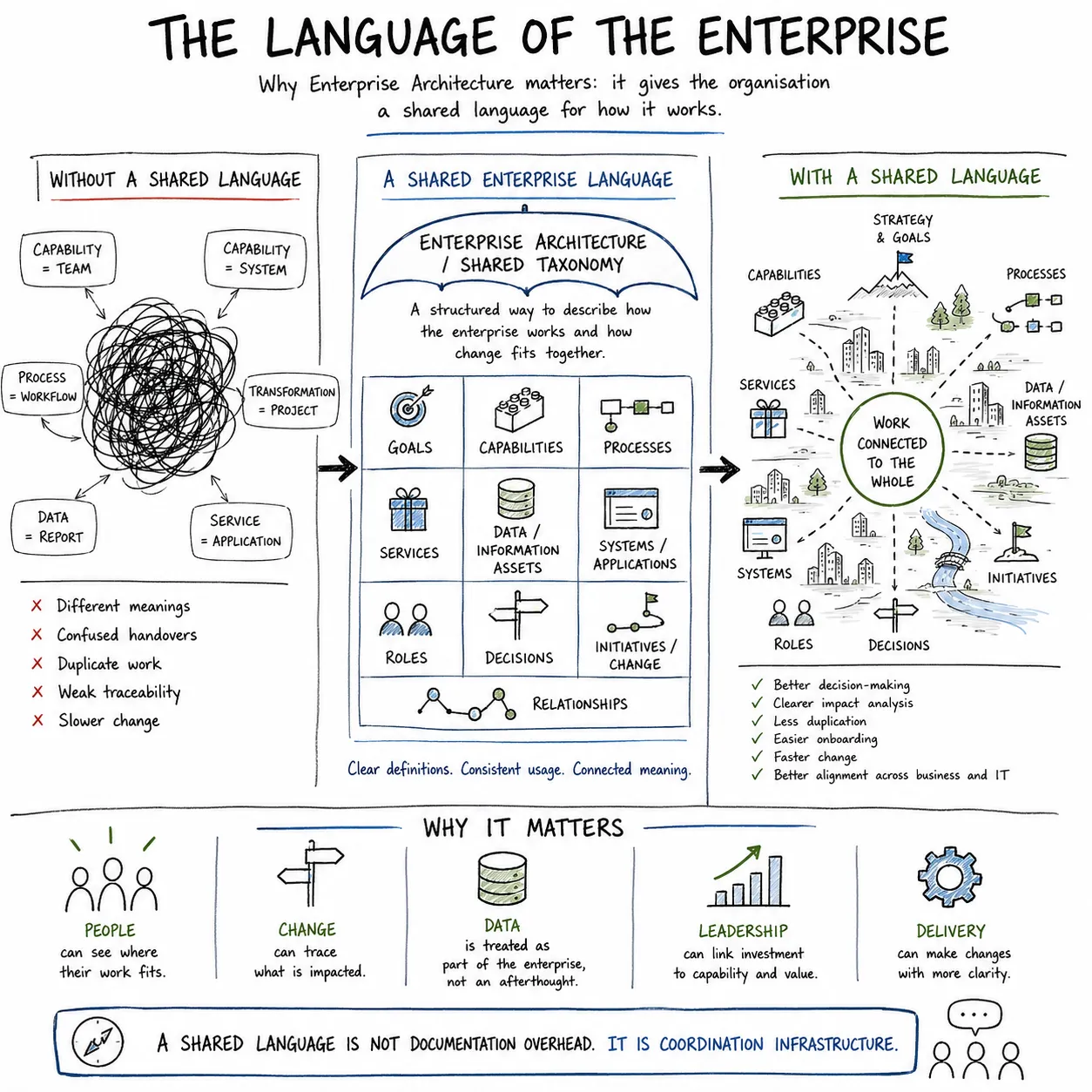
Before an organisation can coordinate effectively, it needs more than shared goals. It needs shared meaning. A clear enterprise taxonomy is not a documentation exercise. It is the language infrastructure that allows people to understand how their work connects to the whole.
I've been thinking about what actually separates successful organisations from unsuccessful ones operating in the same industry, with access to much the same talent, technology, capital and market conditions.
Leadership, culture, strategy, execution - all of those matter. But I keep returning to something more basic.
A successful enterprise, in my experience, looks a lot like a successful partnership! Not in the loose metaphorical sense. I mean it structurally. What makes a partnership work is not only shared values or compatible personalities. It is that two people can actually understand each other. They refer to the same things. When one speaks, the other does not need to keep translating.
There is shared meaning.
Now scale that to an organisation of a thousand people. Or fifty thousand. That is where things start to break. So what we really need is a shared language.
The fragmentation nobody names
The challenge in many large organisations is not that people disagree. It is that they are not even talking about the same things, even when they use the same words.
A "transformation initiative" means something different to a CIO than it does to a delivery manager, a business analyst, and the call centre agent who will eventually be affected by it. A "capability" to someone in strategy is a "system" to someone in IT and a "team" to someone in operations.
Everyone sounds aligned because the words are familiar. But underneath the words, the meanings are different. This is why so many conversations feel productive in the room and confused immediately afterwards.
That is not simply a communication problem. It is a language problem. And organisations rarely treat it as one.
What organisations invest in instead
Walk into most large organisations and you will find compliance training, leadership programs, culture initiatives, engagement surveys, vision posters and strategy roadshows. Some of these are genuinely useful.
But very few address the underlying issue: people across the enterprise are operating in different conceptual universes. So they learn the organisation informally. They inherit the vocabulary of their predecessor. They adapt to the language of their immediate manager.
Over time, the organisation becomes a collection of local languages pretending to be one enterprise.
Taxonomy as infrastructure
This is where Enterprise Architecture has something genuinely important to contribute. Not through frameworks or governance documents. Through the patient work of building a shared enterprise taxonomy - a clear, structured vocabulary for the things the organisation does and is: goals, capabilities, processes, data, services, systems, initiatives, decisions and the relationships between them.
When this exists, something important changes. People can locate their work within the larger picture. A leader can ask whether a proposed investment connects to a capability gap or duplicates an existing initiative, and get an answer that makes sense. A delivery team can understand whether they are changing a system, improving a process, or enabling a capability.
The work has an address.
The same way a city needs a shared street addressing system for navigation to work, an enterprise needs a shared conceptual addressing system for coordination to work. Without it, people can still move. But they waste enormous energy describing where they are, where they are going, and what they think they are referring to.
Where taxonomy becomes organisational memory
A taxonomy hidden inside an architecture repository is not enterprise language. It is an architecture artefact.
For it to matter, it has to help leaders make decisions, help delivery teams understand impact, and help new starters understand where they fit. It has to survive changes in leadership, strategy and systems. Because if the language of the enterprise is embedded only in the people who happen to work there today, it leaves with them. If it is embedded in a coherent structure that sits above any individual, it persists.
That is where taxonomy becomes more than classification. It becomes organisational memory.
The real onboarding problem
Every person who joins an enterprise has to learn its language. Most never fully learn it because it was never formally defined. They learn fragments, acronyms and the dialect of their team. But they rarely receive a coherent explanation of how the enterprise understands itself.
Many organisations are not struggling because they lack intelligence, effort or ambition. They are struggling because too many people are trying to coordinate without a shared language.
In my opinion, Enterprise Architecture is one of the few disciplines that actually knows how to build one. The question is whether we are willing to treat language as infrastructure, rather than leaving it to chance.
Comments and thoughts
Share your thoughts on this topic, or leave a question.
Loading comments...